 Coinomize
Pricing
Coinomize fees, delays and minimums.
The fee is not only what you pay — it's a privacy lever. The wider the range you allow, the harder it is to match your withdrawal to your deposit by amount.
Coinomize uses a fee model that's unusual for the space. Instead of a single flat percentage, you pick a value inside a range, and the mixer randomises the final amount inside that range. Two things happen: the operator gets paid, and your withdrawal amount stops being a predictable function of your deposit. Both are intentional.
The fee structure at a glance
| Parameter | Coinomize range | What it controls |
|---|---|---|
| Service fee | 0.5% – 3.0% | Operator payment and amount randomisation |
| Network fee | Paid by Coinomize from reserve | On-chain confirmation of withdrawal |
| Minimum deposit | 0.005 BTC | Below this the pool can't anonymise effectively |
| Maximum per session | Up to current reserve liquidity | Shown live before you confirm |
| Delay | Instant – 96 hours | Temporal separation of deposit and withdrawal |
| Output addresses | 1 – 10 | Splitting reduces amount-based correlation |
Why a range, not a fixed fee?
If every Coinomize withdrawal had exactly the same percentage deducted, an analyst could compute "input minus 1.5%" and look for a withdrawal of that size landing roughly when expected. A fixed fee turns the mixer into a slightly noisy calculator. By contrast, a range from 0.5% to 3% means the analyst has to consider a whole band of possible outputs for every deposit. Multiply that by ten possible output addresses and a window of up to 96 hours, and the candidate set explodes.
Practically: if you want maximum privacy, set a wide fee range. If you want to minimise cost, set it narrow at the bottom. The mixer doesn't object either way — the choice is yours.
The delay is a privacy lever too
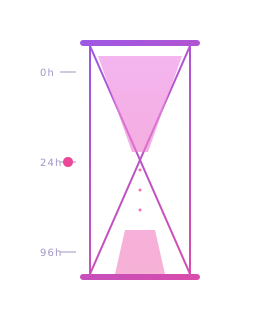
Delays from zero to 96 hours are allowed. Instant withdrawals are convenient but give an analyst the easiest possible temporal pairing — a deposit arrives, a similar amount leaves the pool minutes later. A delay of even a few hours pushes the candidate set wider; a delay of two or three days renders timing-based linking nearly useless on its own.
Different outputs in the same session can use different delays. This is recommended for any mix that involves more than one destination address. A withdrawal pattern like "4 hours, 22 hours, 51 hours, 70 hours" is much harder to back-correlate than "all four addresses, same 24-hour mark".
Network fees and dust
The Bitcoin network fee for the withdrawal transaction is paid by Coinomize out of its reserve, not deducted from your output. The amount the mixer shows you is what arrives. That said, the calculation assumes a reasonable fee for current mempool conditions — during fee spikes the mixer may delay non-urgent withdrawals slightly to avoid overpaying, which is normal behaviour.
Avoid mixing tiny amounts. Below the 0.005 BTC minimum the privacy gain is marginal — the pool can't anonymise dust effectively because dust outputs stand out. Aggregate small balances into one wallet before mixing rather than running a dozen tiny sessions.
Refunds and reserve coverage
If a deposit arrives that doesn't match the parameters in your letter of guarantee — wrong amount, wrong address, missed window — Coinomize support resolves it case-by-case using the saved letter as the source of truth. The reserve is large enough to handle the normal volume of edge cases without delay. Genuine refunds, when warranted, are paid from the reserve rather than from new deposits.